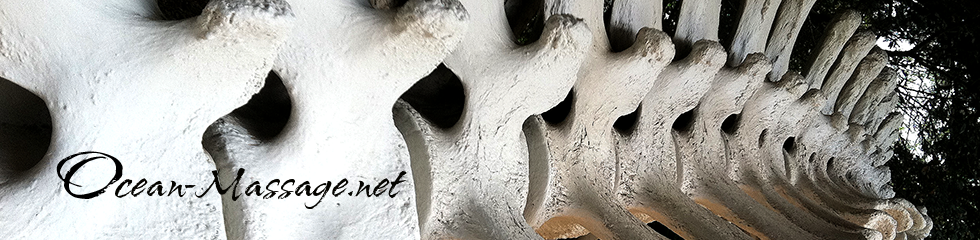
 Whale skeleton, McKerricker Beach, Fort Bragg, California
Bull Seal Skeleton, Noyo Center for Marine Science, Fort Bragg, California. The shape of the shoulder blade is very similar to that of humans
Articles By Phil Miller
2026-05-22
About Shoulders One of the simplest ways of understanding the structure
of the human form is that it is a pile of blocks held together with rubber bands with a bowling ball balanced on top.
The folks who invented the floatation tank, also known as an isolation tank, in the 60's and 70's estimated that 70 to 80 percent of our energy goes into maintaining our vertical posture. So learning to balance the bowling ball on top of the pile of blocks, rather than holding it up goes a long way toward having more physical energy.
There are two crosses in the basic structure of the body. The weight of the head, arms and torso travels down to what I call the southern cross, the pelvis, and is spread sideways to two posts, the legs, that support the upper body.
The northern cross, the arms and shoulders where they meet the spine a little below the head looks very much like the Egyptian symbol the ankh. Cultural perception is that the arms start at the ball and socket joint at the top of the upper arm bone and travel to the hand, but this is not accurate. The shoulder blade is the "root" of the arm, and is involved in everything we do with our arms and hands.
Most of the joints of the body have sockets that define the motion of the joint. The hinge joints of the knees and elbows, the ball and socket joints in the hips and shoulders. The shoulder blades are one of the few exceptions. The shoulder blade is a triangular shaped flat bone that floats across the back of the rib cage and is held in place by muscles, strong muscles that connect to the spine between the shoulder blades, connect to the neck and the base of the skull, to the ribcage, and to the arms.
There is a cultural tendency, in my opinion, to lock our shoulder blades down against the back of the ribcage any time we use our arms; lifting, pulling, pushing, etc, thinking that it is going to give us better leverage. What actually happens is that if the shoulder blade is locked down rather than included in the motion, it impinges on, and can eventually damage, the rotator cuff, the neck and the upper spine.
One of my specialties as a massage therapist is helping clients loosen their shoulder blades using techniques that I have developed over years of professional practice. For those who are unable to work with me directly, some suggestions:
First, increase your awareness of your shoulder blades. Notice other people's shoulder blades from behind, some are free, some are locked down. Can you tell the difference?
Exercises
The simplest exercise to become aware of your shoulder blades is swinging your arms. As you walk down the street, do your arms swing freely in cadence with your steps? Are your shoulder blades included in the arm motion? Are you walking erect, your torso balanced on your hips, your head balanced on your spine?
Several videos from Musetta Vander to which I refer many clients because they activate and help you become aware of the shoulder blades:
The Swaying Exercise
The Lung Exercise
The Heart Exercise
I recommend all of her Qi Gong videos.
One more note for now. Tension is something we do to ourselves. It is how it works. The mechanism that turns muscles on, creates muscular tension, and turns muscles off, relaxes those muscles, that switch is internal to each of us. No one can relax your muscles but you. Many people spend their lives being at the effect of something they are doing to themselves.
The perception that allows us to be aware of what is going on in our muscles is different than our ordinary perception, and takes practice developing. The human form is constructed such that the eyes look outward. Feeling your muscles requires that you turn your attention inward, and a massage is a great way to practice developing that awareness.
Poetry By Phil Miller
2017-02-22
Some days
the ocean needs
a rock
to crash against,
Other days
a beach
to caress.